Crack Injection in Niagara
Epoxy and polyurethane injection that seals foundation cracks from the inside, permanently.
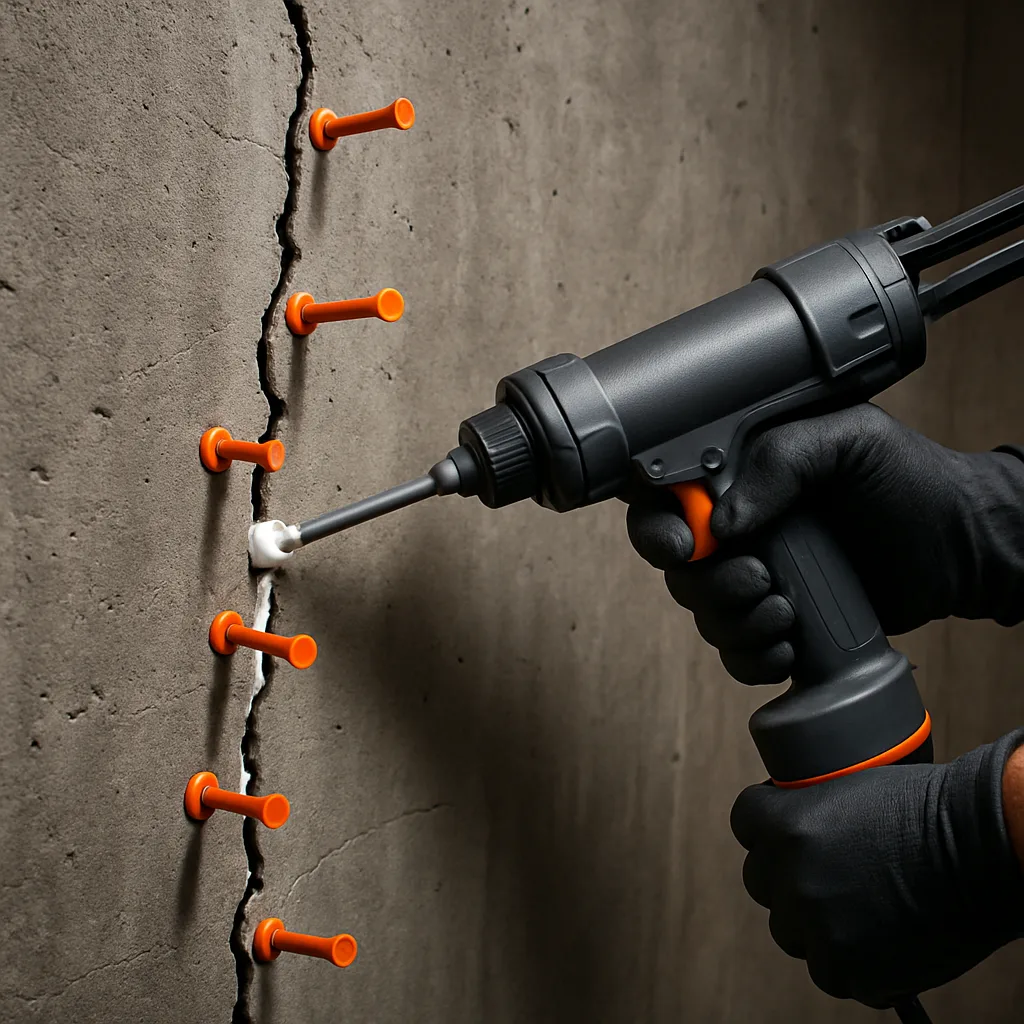
The call usually comes in March. The snowpack along the Escarpment lets go over a warm weekend, the clay around the house is still frozen a foot down, and the water that cannot soak away ends up in the one place it can find a path: a hairline crack in a poured concrete wall that has been dry for ten years. By Monday there is a damp line running from the corner of a basement window down to the slab, and a homeowner in Merritton or Stamford is on the phone wondering whether the whole foundation is failing.
Almost always, it is not. A single vertical crack in a poured wall is one of the most fixable problems a Niagara house can have, and crack injection fixes it from inside, without a shovel touching the yard. This page explains how the repair works, when we recommend epoxy and when we recommend polyurethane, what it costs, and why doing it right in Niagara means paying attention to clay, freeze-thaw and the water table.
When a crack is a candidate for injection
Injection is a repair for cracks in solid poured concrete. It is not a fix for hollow block walls, and it is not a structural fix for walls that are moving. Signs that you have a good candidate:
A vertical or diagonal crack in a poured wall
Concrete shrinks as it cures, and a foundation wall that is 30 or 40 feet long has to crack somewhere to relieve that. The result is the classic shrinkage crack: roughly vertical, often starting at a corner of a basement window or a beam pocket, running down toward the floor, usually a hairline at the top and slightly wider at the bottom. This is the crack injection was invented for.
A crack that leaks, or stains, or grows white powder
Water coming through does not have to be dramatic. Look for a rust or tan stain that follows the crack, a chalky white deposit (efflorescence, the minerals left behind when water evaporates), or paint that bubbles along a line. All of these mean water is travelling through the wall.
A crack you have already patched
Hydraulic cement, caulking and paint-on sealers plug the surface. They do nothing about the water sitting in the crack behind them, and in a Niagara winter that water freezes, expands, and pops the patch. If you have re-patched the same crack more than once, that is your answer.
Tie rod holes and pipe penetrations
Poured walls from the 1960s onward have snap-tie holes on a grid, and older walls have through-bolt holes. Both leak when the original plug fails. They are injected the same way a crack is, and we treat them as part of the same visit.
If instead you have a horizontal crack, a wall that bows inward, or stair-step cracking through block or brick, stop here and read our foundation crack repair page. Those need an assessment first, not a syringe.
Epoxy vs polyurethane: the honest trade-off
Both materials are injected under pressure through ports bonded to the face of the wall, and both fill the crack through the full thickness of the concrete. Where they differ is what happens after.
Polyurethane is a flexible foam. It reacts with water, expands to many times its liquid volume, and chases the water into every branch of the crack. It cures wet, it tolerates a little seasonal movement, and it stays sealed when the wall flexes a hair during freeze-thaw. For a leaking crack in a house that is otherwise stable, this is what we use nine times out of ten.
Epoxy is rigid. Cured epoxy is stronger than the concrete around it, so it welds the two faces of the crack back together and restores the wall’s continuity. It is the right call when an engineer wants the crack structurally bonded, or when a crack sits under a point load like a beam pocket. The catch: epoxy needs a mostly dry crack to bond well, it cannot follow a crack that is actively moving, and if the underlying cause of movement is not addressed the wall will simply crack again beside the repair.
We carry both. The material is chosen for the crack, not for what is on the truck.
How a crack injection visit goes
- Inspect the whole wall, not just the crack you called about. We check every wall for staining, efflorescence, other cracks, tie rod holes and the condition of pipe penetrations. Most basements that have one leaking crack have a second one that has not started yet.
- Expose and clean the crack. Any paint, parging or old patch material along the crack comes off with a grinder or wire wheel so the surface paste bonds to bare concrete.
- Set the injection ports. Ports go on the face of the wall every 8 to 12 inches along the crack, spacing tightened for thicker walls.
- Seal the surface. A fast-setting surface paste covers the crack between ports so the material we inject has nowhere to go but into the wall.
- Inject from the bottom up. Starting at the lowest port, we pump material until it appears at the next port up, then cap and move. This is how you know the crack is filled through, rather than just at the surface.
- Trim, clean and document. Ports are snapped off, the surface is dressed, and you get photos of the finished repair with the written warranty.
One crack is typically a one to two hour visit. A basement with four or five cracks and a row of tie rod holes is usually still a single day.
Why homeowners choose injection over digging
- No excavation. No trench along the wall, no torn-up interlock, no dead hedge, no three-day mud pit in the side yard.
- Works in winter. Exterior waterproofing waits for the ground to thaw. Injection happens indoors, in February, while the crack is actively leaking and easiest to diagnose.
- Fills the whole crack, not the surface. Pressure injection pushes material through the full wall thickness, which is why it holds where surface patching fails.
- Cost. A single injected crack is a fraction of the price of exposing and coating the same wall from outside.
- Same-day use. There is no curing period you have to work around. Storage goes back against the wall that afternoon.
- A written warranty. Every injected crack we do is covered in writing against leaking through that crack.
What drives the cost
- Length of the crack. More ports, more material, more time.
- Wall thickness. An 8-inch poured wall takes less material than a 10- or 12-inch wall, and older homes on the Escarpment slope sometimes have thicker walls than you would expect.
- Active leaking. A crack running water at the time of the repair needs a faster-reacting polyurethane and more careful staging.
- Access. Bare concrete is the easy case. A finished basement means cutting drywall and working around framing, and a crack behind a furnace or panel takes longer.
- Number of repairs in the same visit. Setup costs are shared, so the second and third crack on the same day cost less than the first.
- Epoxy vs polyurethane. Structural epoxy injection is priced higher because of material cost and prep.
We give you a firm written number after a free on-site inspection. There is no charge to have us look, and there is no obligation.
What a Niagara crack injection has to account for
The technique is the same everywhere. The conditions around a Niagara foundation are not, and they change how we approach the work.
Clay that holds water against the wall
South of the Escarpment, most of Niagara sits on the Haldimand Clay Plain: dense glacial lake clays and silts that drain slowly and stay saturated well into late spring. North of the Escarpment, the Lake Ontario shore communities of St. Catharines have their own lacustrine clays. In either case, a Niagara foundation is not sitting in free-draining soil. It sits in a bowl of clay that fills with water every thaw and every heavy rain, and that water pushes on the wall until it finds a crack. This is why a crack that leaked once will leak again, and why a surface patch does not survive here.
Freeze-thaw that never quite stops
Niagara winters hover around freezing rather than staying deep below it, thanks to the two lakes. That sounds gentle. For a crack, it is the worst case: water in the crack freezes, expands, thaws and refills dozens of times per winter, widening the crack slightly each cycle. Polyurethane’s flexibility matters here far more than it would in a place with one hard freeze and one spring thaw.
A high water table near the lakes and the canal
Lakeshore neighbourhoods in St. Catharines, the Crystal Beach and Ridgeway areas of Fort Erie, Chippawa along the Welland River, and any street near the Welland Canal can have groundwater sitting close to the footing for weeks at a time. Sustained hydrostatic pressure is different from a rain event. It is patient. A crack in these zones needs material injected through the full thickness of the wall, and it usually needs a conversation about what the weeping tile and sump are doing, which is where our basement waterproofing work starts.
Poured vs block, by era
Niagara’s housing stock tracks its industrial history. The wartime and early postwar streets in Welland, Thorold and the older parts of St. Catharines have plenty of concrete block foundations, and some older rubble and brick. Block cannot be injected: water travels inside the hollow cores and comes out wherever it likes, so the fix is different. From roughly the 1960s forward, poured concrete becomes standard, and those are the walls injection is made for. We tell you on the first visit which one you have and what that means.
Weeping tile and sump realities
Ontario Building Code requires foundation drainage (weeping tile) around a basement and, where a sump pit is used, a covered pit at least 750 mm deep with an automatic pump when gravity drainage is not practical. Older Niagara homes were built under earlier rules, and many original clay-tile drains are silted or collapsed. Several Niagara municipalities, including Niagara Falls with its Weeping Tile Removal Assistance Program, offer help to homeowners disconnecting weeping tile from the sanitary sewer and adding a sump. Injection fixes the crack. If the water around the house has nowhere to go, we will say so.
Permits, code and paperwork
Interior crack injection is a repair, not structural work, and does not require a building permit in Niagara municipalities. If a crack is assessed as structural and an engineer specifies epoxy bonding or additional reinforcement, that engineer’s letter becomes part of your file and we work to it. For a home sale, buyers and home inspectors routinely ask for documentation of foundation repairs; the photos and written warranty we leave you with are exactly what they want to see.
Book a free crack inspection
If there is a crack in your basement wall that has stained, leaked, or simply appeared since last fall, have someone look at it before the next thaw rather than after. The inspection is free, it takes under an hour, and you will leave it knowing whether you have a shrinkage crack that can be injected in an afternoon or something that needs more. Call (289) 271-5869 or request a free inspection online and we will get to you across St. Catharines, Niagara Falls, Welland, Fort Erie, Thorold and the rest of the region. If the crack is running water right now, mention that when you call and we will move it up the list.
How It Works
Free Crack Inspection
We inspect the crack from inside the basement, check for signs of movement or structural concern, and confirm whether injection is the right repair before anything is booked.
Crack Preparation
The crack is cleaned along its full length, surface ports are set at regular intervals, and the face of the crack is sealed with epoxy paste so the injection material stays inside the wall.
Injection
Epoxy or polyurethane is injected port by port from the bottom up until the crack is filled through the full thickness of the wall, not just at the surface.
Verification & Warranty
We confirm the crack is filled end to end, remove the ports, and walk you through the finished repair. Your injection is backed by a written warranty against leaking.
Frequently Asked Questions
Should I use epoxy or polyurethane injection?
Polyurethane is the usual choice for leaking cracks. It reacts with water and expands to fill the crack even while it is wet. Epoxy is used when structural bonding is needed, because cured epoxy is stronger than the surrounding concrete. We assess each crack and recommend the right material.
How much does crack injection cost in Ontario?
Most single foundation crack injections in Ontario fall in a broad range of roughly $400 to $900 per crack, depending on the length of the crack, wall thickness, access and whether it is actively leaking. We confirm a firm written price after a free inspection, before any work begins.
Does it matter if the crack is actively leaking or dry?
No, and you do not need to wait for it to dry out. Polyurethane injection is designed for wet, actively leaking cracks and cures by reacting with the water inside the crack. Dry cracks can be injected with either polyurethane or epoxy depending on the goal of the repair.
What is the difference between vertical and stair-step cracks?
Vertical and slightly diagonal cracks in poured concrete are usually shrinkage cracks and are excellent candidates for injection. Stair-step cracks in block or brick foundations often indicate movement or settlement, which is a structural concern. Those need a proper assessment before any injection is considered.
How long does crack injection last?
A properly done injection fills the crack through the full thickness of the wall and is considered a permanent repair for that crack. Our injections are backed by a written warranty against leaking. New cracks can still form elsewhere in a foundation, which is why we inspect the whole wall during the visit.
Is the repair done from inside or outside?
Crack injection is done from inside the basement, so there is no excavation and no damage to landscaping, decks or driveways. Exterior excavation and waterproofing is reserved for situations injection cannot solve, such as badly deteriorated block walls or failed exterior drainage.
Can you inject a crack behind a finished basement wall?
Yes, but we need access to the concrete. Usually that means cutting a section of drywall roughly the width of the crack from floor to the top of the wall, doing the injection, and leaving a clean opening for your drywaller. We mark the cut so it is as small as possible.
How long does the injection take and when can I use the basement?
A typical single crack takes one to two hours from setup to cleanup. Polyurethane reacts within minutes and epoxy cures over several hours, but there is nothing to wait for on your end. You can put furniture and storage back the same day.